How to Start a Gas Business in Kenya With KSh 50,000: A Guide for M-Pesa Agents, Shop Owners and New Dealers
Starting a cooking gas business in Kenya does not always mean renting a separate shop and depending on gas sales alone. If you already operate an M-Pesa outlet, an Equity agent shop, a mini-mart, a hardware shop or another retail business, you may be able to add cooking gas sales as another source of income.
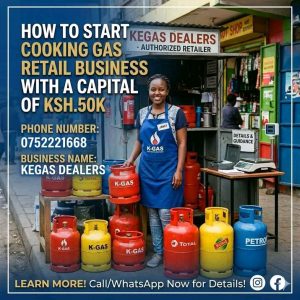
With a starting stock budget of KSh 50,000, you can explore a small LPG retail operation, provided you first confirm that your premises can meet the applicable safety and licensing requirements and that you have an authorised supply arrangement.
The important decision is not simply how many cylinders KSh 50,000 can buy. You also need to choose the right cylinder sizes, understand the demand in your area, arrange compliant storage and keep enough working capital to operate the business.
This guide explains how to start a gas business in Kenya with KSh 50,000, how to incorporate gas sales into an existing business, and how to select an appropriate starting stock of 6kg and 13kg cylinders.
Can You Start a Gas Business With KSh 50,000?
Yes. KSh 50,000 can be used as a starting stock budget for a small, carefully planned gas retail operation. However, it should not be presented as a guaranteed total cost of establishing a fully compliant LPG business.
Your actual startup capital will depend on:
- Whether you already have a suitable business premises.
- Whether the premises can meet LPG storage and safety requirements.
- The brand and cylinder sizes you intend to stock.
- Your wholesale supplier’s current prices.
- The type of distributorship or retail arrangement available to you.
- Licensing, county permits and fire-safety requirements.
- Storage cage, signage, transport and other operating costs.
- How much working capital you need after purchasing stock.
If you already run a shop, some business expenses may already be covered. That can make adding gas sales more practical than setting up a completely new retail outlet.
Important: Treat KSh 50,000 as a stock-planning budget, not a promise that every person can legally open and operate an LPG outlet with KSh 50,000 in total.
1. Add Cooking Gas Sales to an Existing Business
One way to enter the LPG retail market is to incorporate cooking gas sales into a business that already attracts customers.
Instead of relying on gas customers alone, you can use your existing customer relationships and shop visibility to introduce another product category.
M-Pesa and Mobile Money Agent Shops
An M-Pesa outlet receives regular visits from customers making deposits, withdrawals and other transactions. Some of those customers may also need cooking gas.
Adding LPG retail can create an opportunity to serve existing customers with another essential household product.
However, the presence of an M-Pesa agency does not automatically authorise the premises to store or sell gas. The LPG storage area, premises and business must meet the relevant regulatory and safety requirements.
Equity Agent and Banking Service Outlets
An existing Equity agent or other banking service outlet may also explore adding cooking gas sales where the premises are suitable.
The business owner should first check the terms of their agency agreement and obtain any necessary consent from the relevant institution before introducing another activity.
Keep financial agency operations separate from LPG stock records and transactions.
Mini-Marts and General Retail Shops
A mini-mart may already sell household essentials, food items, cleaning products and other fast-moving goods.
Cooking gas can complement these products because customers regularly need refills and replacement cylinders.
The owner must still establish a safe, compliant LPG storage and sales area. Gas cylinders should not simply be placed inside the shop alongside ordinary merchandise.
Hardware and Building Supply Shops
Some hardware businesses serve landlords, homeowners, contractors and households. These customers may also require cooking gas cylinders, regulators, hoses and other approved accessories.
A hardware shop can investigate LPG retail as an additional product category, provided its premises and operations are suitable and compliant.
Existing LPG Delivery and Household Service Businesses
A business already serving households may also explore cooking gas distribution or retail.
For this model, the owner should understand the applicable rules for LPG retail, cylinder handling and transportation before offering delivery services.
2. Why Combine Gas Sales With Another Business?
An existing business may provide several advantages:
- Existing customers: You already have people visiting your premises.
- Business visibility: Customers may discover your gas products through your existing shop.
- Shared business administration: You may already have staff, records and payment systems.
- Additional revenue opportunity: Gas sales can complement your existing products and services.
- Customer convenience: Customers may be able to access several services from one location.
These advantages do not guarantee profit. You should track LPG sales separately to understand stock movement, margins, delivery costs and the actual contribution to your business.
3. Which Gas Cylinders Should You Stock With KSh 50,000?
For a beginner, the two sizes worth investigating first are:
- 6kg gas cylinders: A smaller option for households looking for a more affordable initial purchase or refill.
- 13kg gas cylinders: A common household cooking gas size that may serve customers who use gas regularly.
You should not choose quantities based on guesswork. The right stock mix depends on the buying habits of customers around your shop.
A Practical Starting Stock Strategy
If you are adding gas sales to an M-Pesa shop, Equity agent outlet or mini-mart, consider a modest mix of 6kg and 13kg cylinders.
A sensible approach is to:
- Ask nearby households which cylinder sizes they use most often.
- Find out which brands customers already prefer.
- Obtain current wholesale quotations for the 6kg and 13kg options.
- Confirm the supplier’s minimum order quantities and distributorship conditions.
- Check the storage capacity and safety suitability of your premises.
- Select quantities that allow you to test demand without tying up all your money in slow-moving stock.
Do not assume that every brand can be stocked under the same arrangement. Obtain the required written authority from the relevant brand owner or authorised agent before retailing its cylinders.
Example of a KSh 50,000 Stock-Planning Exercise
Use the following calculation when requesting a quotation:
| Stock item | Quantity | Supplier quotation | Total |
|---|---|---|---|
| 6kg cylinder stock | To be agreed | KSh ___ | KSh ___ |
| 13kg cylinder stock | To be agreed | KSh ___ | KSh ___ |
| Total stock budget | KSh 50,000 |
This is a planning template, not a current price list. Ask your supplier to distinguish between filled-cylinder stock, empty-cylinder arrangements, cylinder deposits and any other charges.
If KSh 50,000 is the entire amount available to establish the business, do not spend all of it on stock before accounting for licensing, approved storage arrangements, safety equipment, transport and operating expenses.
Our recommendation: Start with a manageable 6kg and 13kg combination, monitor sales for the first few weeks and restock the size that customers request most frequently.
4. Can You Sell Gas From the Same Premises as an M-Pesa Shop?
Possibly, but the premises must be assessed for LPG compliance before you begin.
The Petroleum (Liquefied Petroleum Gas) Regulations, 2025 set requirements for LPG businesses, including licensing, storage, retailing and safety.
Among other requirements, the regulations provide that:
- A person undertaking an LPG business must apply for the relevant licence.
- Retailing another brand owner’s cylinders requires prior written consent from the brand owner or its authorised agent.
- Cylinders must be stored and displayed in accordance with applicable Kenyan Standards.
- LPG cylinders must not be stored in enclosed, poorly ventilated spaces or in basements or ground floors of buildings.
- Required minimum separation distances from buildings, roads, public thoroughfares, public gathering places and potential ignition sources must be observed.
- A licensed retailer must have an appropriate working fire extinguisher and display emergency contacts.
- Retailers must maintain cylinder purchase and sales records and issue the required receipts.
These requirements mean that an ordinary shop, even one with strong customer traffic, may not automatically qualify as an LPG retail point.
Before investing in stock, contact the Energy and Petroleum Regulatory Authority (EPRA) and the relevant county authorities to establish whether the proposed premises and storage arrangement can be approved.
5. LPG Licensing and Business Requirements in Kenya
Before opening an LPG retail point, establish which licence and approvals apply to your intended business model.
The EPRA requirements for retailing LPG in cylinders include business registration documentation, tax compliance, a county single business permit, fire clearance and proof of cylinder ownership or written distributorship authority from a licensed LPG cylinder brand owner.
The applicable requirements should be checked directly with EPRA because the documents and conditions depend on the licence category and current regulations.
You should also consider:
- Business registration and KRA obligations.
- County business permit requirements.
- Fire-safety clearance.
- Suitable cylinder storage facilities.
- Brand-owner or authorised-agent consent.
- Approved cylinder handling and record-keeping procedures.
- Any applicable insurance and safety obligations.
Do not begin selling LPG simply because you have purchased cylinders from a wholesaler. Confirm the licensing and premises requirements first.
6. Where Can You Buy Gas Cylinders Wholesale in Kenya?
Your supplier is one of the most important decisions when starting a gas business.
A reliable wholesale arrangement can help you maintain stock, understand product availability and serve customers consistently.
When comparing wholesale gas suppliers, ask about:
- Wholesale prices for 6kg and 13kg cylinders.
- Filled and empty cylinder options.
- Available LPG brands.
- Minimum order quantities.
- Written distributorship or brand-owner authorisation.
- Delivery arrangements and transport costs.
- Cylinder deposits and exchange conditions.
- Product documentation and proof of legitimate supply.
- Restocking arrangements and customer support.
Do not compare suppliers on price alone. Confirm that the supplier is properly authorised and that the cylinders meet the applicable standards.
For a new retailer with KSh 50,000, it may be more practical to establish a dependable supply arrangement before committing to a large stock purchase.
7. How to Monitor Your Gas Business Alongside M-Pesa or Other Retail Services
When you combine LPG sales with another business, maintain separate records for the gas operation.
Your M-Pesa or shop records should not make it difficult to determine whether the gas business is profitable.
| Business measure | What to record |
|---|---|
| Opening stock | Number of cylinders by brand and size |
| Purchases | Supplier, date, quantity and cost |
| Sales | Cylinder size, brand, quantity and selling price |
| Stock balance | Available filled and empty cylinders |
| Gross margin | Selling price less direct stock cost |
| Operating costs | Transport, staff and other attributable costs |
| Customer demand | Most requested sizes and brands |
| Restocking | Products that sell quickly and those that move slowly |
Review the records weekly during the first month.
This will help you identify whether 6kg or 13kg cylinders are selling faster and how much money should be reinvested in stock.
8. Is a Gas Business Profitable When Combined With Another Business?
Combining LPG sales with an existing business may help reduce some of the costs associated with starting from scratch. However, profitability still depends on the buying price, selling price, stock turnover and operating expenses.
Use this basic calculation:
Gross profit per cylinder = Selling price − Direct purchase cost
Net profit = Total gross profit − Operating expenses
For example, if a cylinder is purchased at KSh 2,500 and sold at KSh 2,800, the gross margin is KSh 300 before transport, staff costs and other expenses.
These figures are only an illustration, not a current wholesale or retail quotation.
Do not calculate your expected monthly profit using a fixed number of cylinders unless you have evidence of actual customer demand and reliable supply.
9. Common Mistakes to Avoid When Starting With KSh 50,000
- Buying stock before checking the premises: Your proposed storage area may not meet the applicable safety requirements.
- Stocking too many cylinder sizes: Begin with sizes supported by local customer demand.
- Buying from unauthorised suppliers: Verify the supplier and brand arrangement.
- Using the ordinary shop interior for cylinder storage: LPG storage must comply with the relevant standards and regulations.
- Spending all available capital on stock: Remember operating expenses and compliance costs.
- Mixing business records: Track LPG purchases, sales and stock separately.
- Assuming an M-Pesa or Equity agency licence covers gas sales: LPG retail has its own regulatory requirements.
- Refilling or transferring gas without authorisation: Do not refill, decant or transfer LPG between cylinders outside an appropriately licensed and authorised operation.
10. How KeGasDealers Can Help You Start
KeGasDealers helps customers explore cooking gas brands, cylinder sizes, wholesale supply options and LPG business opportunities in Kenya.
If you are starting with KSh 50,000, you can enquire about:
- Available 6kg and 13kg wholesale options.
- Suitable starting stock combinations.
- Available brands and cylinder arrangements.
- Wholesale pricing and order requirements.
- Supplier documentation and distributorship guidance, where applicable.
The right stock combination should be based on your budget, location, customer demand and the supplier arrangements available to you.
Contact KeGasDealers before placing your first stock order so that you can compare the available options.
Frequently Asked Questions
Can I start a gas business with KSh 50,000?
KSh 50,000 can be used as a starting stock budget for a small LPG retail operation. However, the full cost of establishing a compliant outlet may be higher depending on premises, licensing, safety requirements and operating expenses.
Can I add cooking gas sales to my M-Pesa shop?
You can explore adding LPG retail to an existing M-Pesa shop, but the premises must meet the applicable LPG licensing and safety requirements. An M-Pesa agency does not automatically authorise LPG storage or sales.
Can I sell gas from an Equity agent shop?
An Equity agent business may explore LPG retail as an additional activity, subject to its agency agreement, the suitability of the premises and the relevant LPG approvals.
Which cylinders should I buy first?
For many small retailers, 6kg and 13kg cylinders are sensible sizes to investigate. The final mix should depend on local customer demand, supplier prices, brand arrangements and approved storage capacity.
Should I start with only 6kg cylinders?
Not necessarily. A 6kg-only stock strategy may work in some locations, but customers in other areas may request more 13kg cylinders. Ask potential customers and nearby households before deciding.
Can I use my existing shop space to store gas cylinders?
Not automatically. LPG cylinders must be stored in a compliant area that meets the relevant ventilation, separation, fire-safety and Kenyan Standards requirements. An enclosed or poorly ventilated shop space is not an acceptable assumption.
Do I need EPRA approval to sell cooking gas?
You should establish and obtain the applicable EPRA licence and approvals before undertaking LPG retail. The requirements depend on the business activity and premises.
Can I sell different gas brands from one outlet?
Retailing another brand owner’s cylinders requires prior written consent from the brand owner or its authorised agent, submitted to EPRA as required by the regulations.
How can I get wholesale gas cylinders in Kenya?
Contact an authorised LPG supplier or distributor and request wholesale prices, brand authorisation details, stock availability, minimum order quantities and delivery terms.
Start Your Gas Business With the Right Wholesale Stock
If you already operate an M-Pesa outlet, Equity agent shop, mini-mart, hardware shop or another retail business, adding cooking gas sales may provide an additional product category for your customers.
With KSh 50,000, focus on a manageable starting stock of 6kg and 13kg cylinders, a reliable authorised supplier and a clear plan for monitoring sales.
Most importantly, confirm that your premises can meet the LPG licensing and safety requirements before purchasing stock.
Contact KeGasDealers on WhatsApp to enquire about 6kg and 13kg wholesale gas cylinder options in Kenya and plan your starting stock.